
Key Takeaways
- With 20/30 vision, you see at 20 feet what someone with sharper sight sees at 30 feet.
- This mild difference from 20/20 is common and can show up at any age.
- Most states let you drive with 20/40 or better, though night trips can feel harder.
- Glasses, contacts, and LASIK can each sharpen your view.
- Regular eye exams help you track changes early.
Your eye chart result reads 20/30, and now you’re left wondering what that means for driving, reading, and screen time. Our team at Precision Eye Care hears this question often from patients across Vancouver, WA. That small gap from 20/20 can feel confusing, yet a comprehensive eye exam can show you exactly where your sight stands.
20/30 vision means your eyesight is slightly softer than the standard 20/20, but it sits close enough that many people barely notice it in daily life.
What 20/30 Vision Means
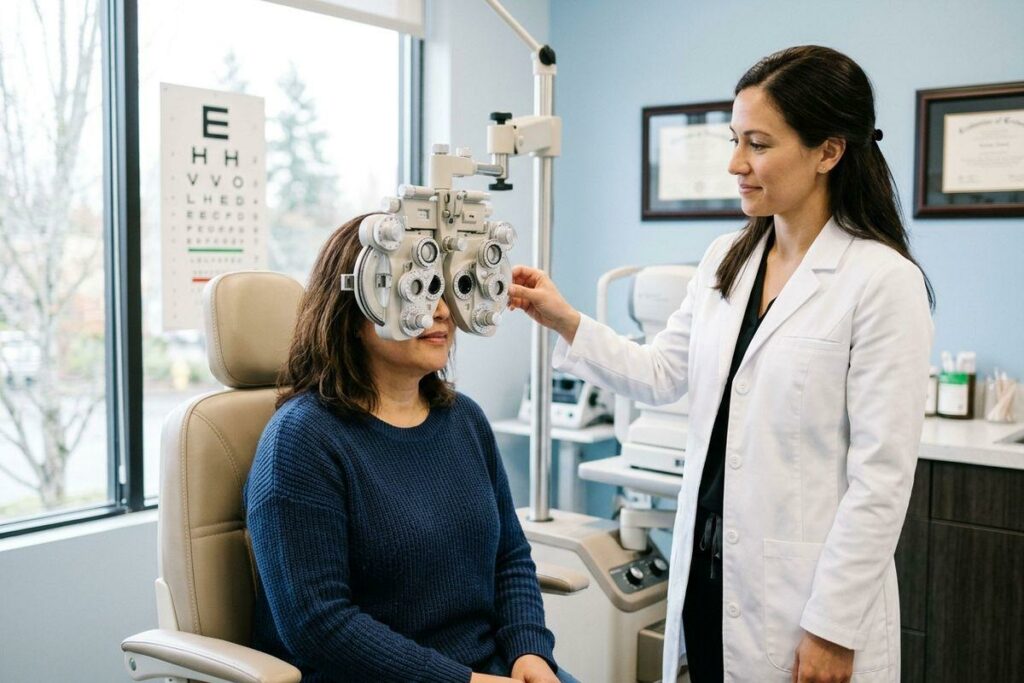
Picture yourself standing 20 feet from an eye chart. The letters look a little soft, and a friend beside you reads a smaller line with ease. That gap is what 20/30 describes. You see at 20 feet what someone else may read at 30 feet.
The numbers come from the Snellen chart, that familiar poster of shrinking letters. It measures how sharply you see detail at a set distance. Moving from 20/20 to 20/30 is a small step, not a steep drop.
Is 20/30 Vision Good or Bad?
20/30 falls into a middle zone. It’s a mild difference from typical vision, and it’s far from legally blind, which sits at 20/200 or worse even with correction. Plenty of people land here, from young readers to folks well into their later years.
Think of it as a nudge rather than a warning sign. Your eyes still do most of the heavy lifting. An optometrist in Vancouver, WA, can tell you whether the number reflects a passing change or something worth watching.
How 20/30 Vision Affects Daily Life
Most of your day probably feels completely normal, but 20/30 vision means things in the distance are just slightly less crisp than average. Those subtle soft spots usually show up only in specific moments:
- Night driving can feel a bit harder, with distant street signs or oncoming headlights lacking sharp definition.
- High-demand tasks, like spotting a highway exit or reading a scoreboard, take a little more visual effort.
- Close-up work might still be totally clear, though mild refractive errors or normal focusing changes can sometimes make fine print feel tiring over a long day.
If any of these sound familiar, a quick check can show you exactly what is going on. Small tweaks, like a mild prescription for driving or evening work, often make a big difference in how sharp your days feel.

Can You Drive with 20/30 Vision?
Yes, in most cases. Most states set the driving standard at 20/40 or better, so 20/30 clears that bar. Night trips can still challenge you, though. Glare from oncoming cars and dim road signs may push you to slow down or lean forward. If night driving feels like a strain, mention it during your next visit.
Ways to Correct 20/30 Vision
You have a few paths to sharper sight, and the right one depends on how you live. Your options can include:
- Glasses give you easy, flexible correction you can slip on and off. Our team also carries fun brands, including the new Meta Ray-Bans.
- Contacts free you from frames for sports, travel, or days you’d rather skip glasses.
- LASIK offers longer-term sharpness for those ready to move past daily lenses.
Do You Need Glasses for 20/30 Vision?
That depends on your lifestyle and comfort. Some people barely notice the difference and go without. Others want crisp detail for driving, reading, or screen work and reach for a pair. An eye exam guides the choice. Your eye doctor can walk you through what fits your days rather than pushing one answer.
How to Protect Your Vision Long-Term
Small habits add up over the years. A steady routine helps you catch shifts early and keep your eyes comfortable. Remember to:
- Book regular eye exams so our team can track changes.
- Follow the 20-20-20 rule, looking at something 20 feet away for 20 seconds every 20 minutes to ease screen strain.
- Eat foods rich in vitamins A, C, and E, like leafy greens, citrus, and nuts, to support eye health.
Come See Us
At Precision Eye Care, our team blends years of experience with friendly, unhurried visits and services that reach beyond glasses, from dry eye therapy to aesthetic treatments and medical-grade skin care. As a locally owned eye care practice in Vancouver, WA, we take time to learn what your eyes and routine need.
Schedule your eye exam today and see the difference clear guidance makes.